 JobClay
Niche job boards
Start a niche job board that has jobs before it has employers
You know a field the big job sites serve badly: search them for your specialty and the few jobs that matter are buried among loosely related roles. A board with only the right jobs would help people in your field, and might earn something on the side.
Then comes the chicken-and-egg problem. Job seekers will not visit a board with no jobs, and employers will not pay to post on a board nobody visits. And as a side project, it should cost little before the first sale, launch in days and get found on Google without a marketing budget.
Free plan, no card needed.
What boards like this charge
What a niche board can charge depends on its audience more than its software. These established boards publish the price of one job post on their own pages, quoted here as read on the day shown. A new board, with no traffic to show yet, may start lower or free.
ProBlogger Jobs (blogging and content writing)
$80 for a 15-day listing, or $160 featured at the top of the board with a newsletter mention; a pack of five standard listings is $320.
Crypto Jobs List (web3 and blockchain)
$200 a job post, and every post is reviewed before it goes live.
LaraJobs (Laravel developers)
From $299 for 30 days, with $49 extras for showing the company’s logo or highlighting the listing in a colour.
larajobs.com/create, read
Remotive (remote jobs)
$299 for a one-month listing, or $398 with a highlight and the company’s logo.
remotive.com/post-a-job, read
Each price is as the page linked under it showed it on the day given, and prices change. Page updated .
Who visits a job board with no jobs, and who pays to post on one?
Nobody, which is why a niche board should get its first jobs before its first employer. The usual way out is backfill: list the jobs companies already publish, so the first visitor finds a full board and a reason to return. On JobClay each one sends applicants to the company’s own posting, and closes on your board at the next read after the company takes it down.
Paying employers come after the visitors, and the first ones want to try before they buy. Let each company post a few jobs free every month: JobClay counts those posts per company and calendar month, then asks for a credit from a package, so a free start can turn into a sale without you chasing anyone.
A worked example
A board for health data jobs
Say you work in health data and know the jobs that matter: clinical data managers, informatics analysts, engineers at companies that build software for clinics and labs. A general job site mixes them with nursing shifts and hospital admin roles. You want a board with only the first kind, starting in the United States.
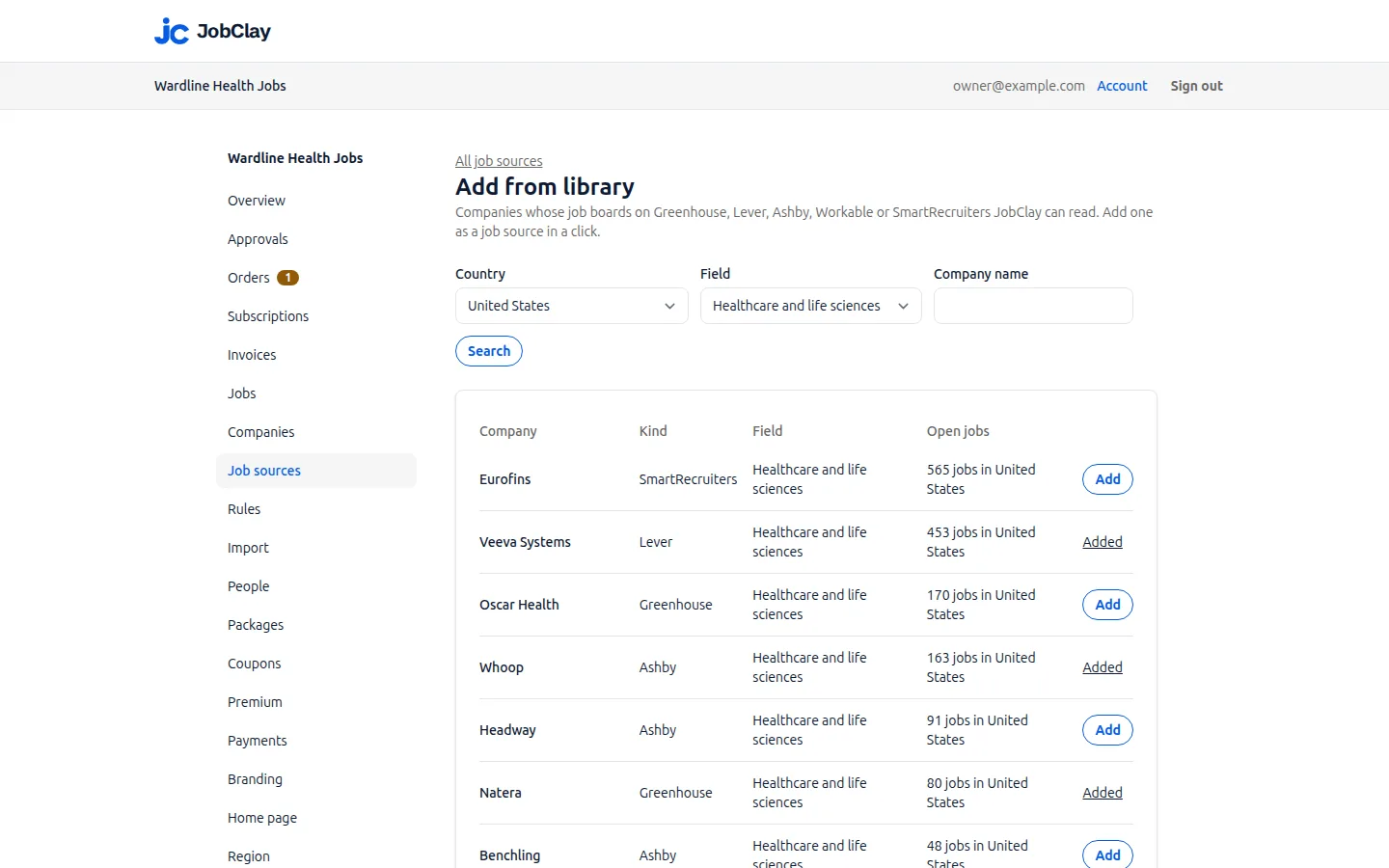
You sign up and the board is live on its jobclay.app address. In the library you filter by Healthcare and life sciences and by the United States, see how many open jobs each company had there at its last check, and add the one with the most of your kind of job.
On the Free plan the board has room for 100 live jobs and 1 job source; employers’ posts count toward its live jobs too. Paid plans run from Starter, $49 a month for 1,000 live jobs and 3 job sources, to Scale, $299 a month for 25,000 live jobs and 30 job sources.
Not every job at a health software company is yours. On the source you list the words of a health data job (“clinical data”, “informatics”, “biostatistics”), have it read descriptions too, and skip “sales” and “nurse”. A rule tags each match with a term such as Analytics, and a list with landing pages gives each term a page of its own.
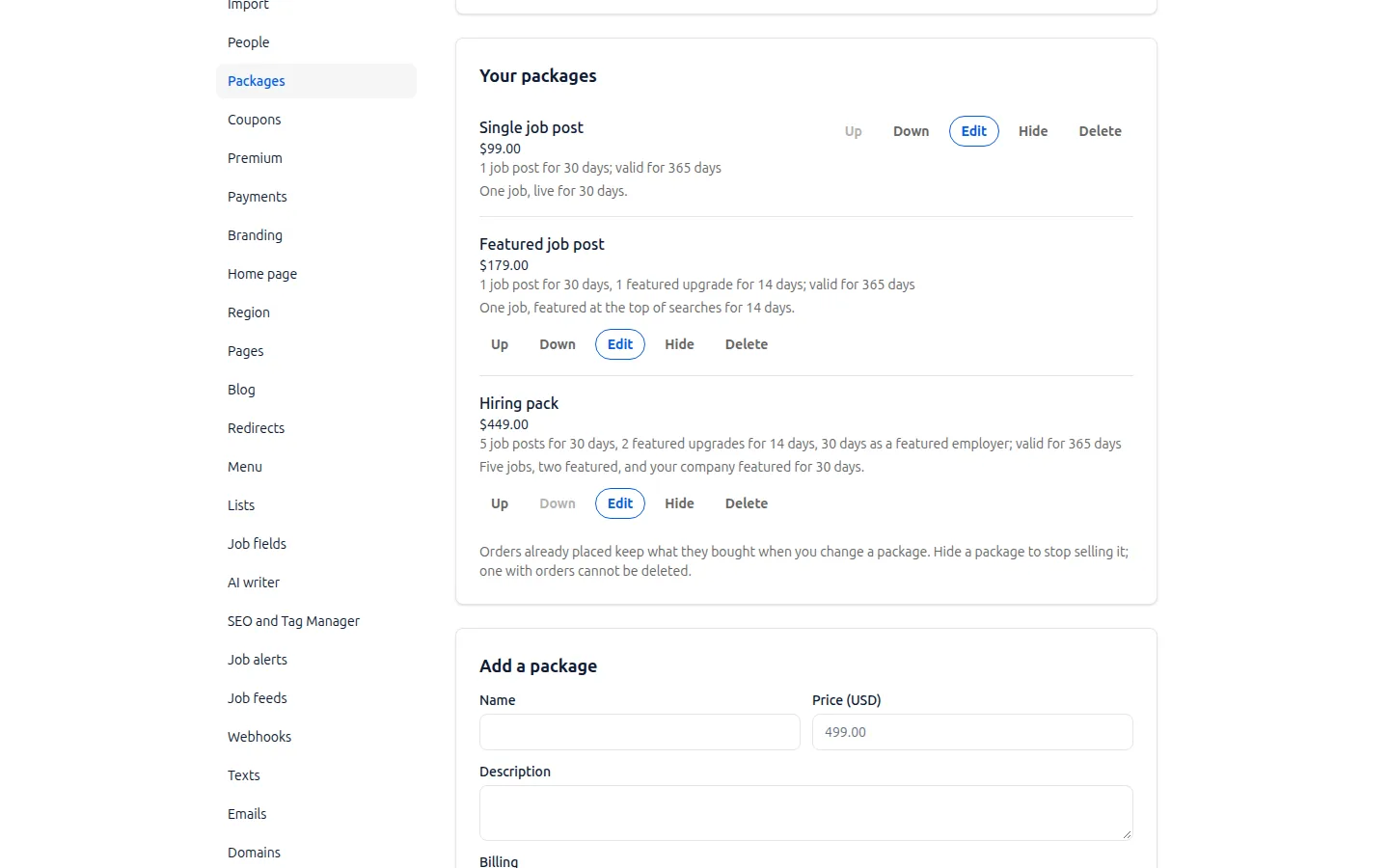
For employers you allow two free posts per company each calendar month and make one package, five posts or one featured post that sits above the rest, in your board’s currency. The package is what you sell once a company wants more, paid into your own Stripe account.
What the example cannot promise is search traffic: how soon Google crawls and ranks a new site is up to Google, and a niche needs people searching for it.
What JobClay does for it
-
A free board that stays up
A new board starts on the Free plan, live at once on a yourname.jobclay.app address, with room for 100 live jobs and 1 job source. There is no card on file and no end date.
-
A library of companies to start from
Companies whose hiring systems JobClay already reads, each counted by country once a week. Filter by field and country, see how many open jobs each one had, and add it as a job source in a click.
-
Only your niche’s jobs
A source can keep only jobs with the words you list in their title or description, skip jobs with other words, and keep only jobs in your board’s country, as a library company added to a board with a country does from the start. Rules can then tag jobs with your terms, set a place or work mode, or mark them entry level.
-
Backfill steps aside for employers
Imported jobs only take the room your plan’s live job limit leaves. An employer’s post that needs room sends the oldest live import back to wait, and a paid post goes live even past the limit, so backfill never pushes out a paying customer.
-
Free posts first, then packages
Free posting can be off, unlimited, or a set number of posts per company each calendar month. After that, a post spends a credit from a package the company bought, priced in your board’s currency and paid by card into your own Stripe account or by bank transfer.
-
Found on Google, Bing and the rest
Job pages carry the JobPosting data Google for Jobs reads, and new and closed jobs go to IndexNow every few minutes, on by default. Google’s Indexing API can be added with a key from your own Google Cloud project.
Where JobClay is the wrong choice
- You want jobs from hundreds of companies at once. Each company you add takes one of your plan’s job sources, and each plan caps them; the pricing page lists the caps. An XML feed that already holds many companies’ jobs counts as one source.
- You plan to sell employers access to candidates. Employers see who applied to their own jobs, with a CSV export, but there is no searchable database of candidates’ resumes to sell, and no messaging between employers and candidates.
- You mean to fill the board from LinkedIn or Indeed. JobClay has no reader for the big job sites, only for companies’ own hiring systems, feeds and careers pages.
How to start
- 1
Start a free board
Sign up with your email or Google, name the board and choose its address. It is live at once, on the Free plan.
- 2
Add your first source
Filter the library by field and country, add a company with plenty of jobs in your niche, and give it your field’s job titles and the near misses to skip. Let its new jobs wait for your approval until you trust them.
- 3
Decide what employers pay
Choose each company’s free posts a month, make a package for when they run out, and connect Stripe or write your bank details.
- 4
Bring people back
Share the board where your field already talks, and keep the job alert sign-up on so visitors get new jobs by email.
Questions
Anything else? See the plans, or start a free board and look around.
Is the Free plan a trial?
No. A board on the Free plan stays live with no end date and no card on file. Its limits are lower than the paid plans’, which the pricing page lists. Move to a paid plan from the console when the board earns.
Where do backfilled jobs come from?
From the places companies publish them: the public job boards of Greenhouse, Lever, Ashby, Workable and SmartRecruiters, XML feeds, and careers pages that carry job markup, the last only where robots.txt allows. Applicants apply on the company’s own posting.
Can I keep backfilled jobs out of Google?
Yes, source by source. Its jobs then carry no job markup, ask search engines not to index them and stay out of your sitemap and job feed, while visitors still see them on the board. Jobs employers post are indexed as usual.
How does the first sale happen?
From an employer who already knows the board. Let companies post a few jobs free each month, and offer a featured post or a pack of posts for when they want more. Card payments go straight to your own Stripe account, with no share to JobClay, and every paid order gets a numbered invoice.
What happens to the board if I stop paying for a plan?
It moves to the Free plan; it does not close. Jobs over the Free plan’s live job limit come down, imports first and paid jobs never, and the newest sources past its limit pause. Nothing is deleted, and a paid plan brings them back.
Related
- Use cases How niche boards, newsletters, communities, local boards, staffing agencies and boards outside the US run on JobClay, and where it is the wrong choice.
- Newsletters Give your newsletter a job board: a feed for a jobs section, packages employers buy into your own Stripe account, and weekly alerts. No native newsletter link.
- Local job boards A local job board for a chamber of commerce, council or town group: approve employers against spam, a page for each town, free posts each month and job alerts.
- Job boards outside the US Start a job portal or jobs board in your own country: salaries and prices in your currency, local dates, bank transfer, a tax line and cities from your country.
- Job sources Fill a new job board from a company library, Greenhouse, Lever, Ashby, Workable, SmartRecruiters, XML feeds and careers pages, with rules and duplicate checks.
- Free job board software Free job board software means four things: a trial, free until launch, a free plan for a live board, or software you host. What each costs, and the limits.
Start your job board today
Free plan, no card needed.